
4/2/2025 Season Debrief

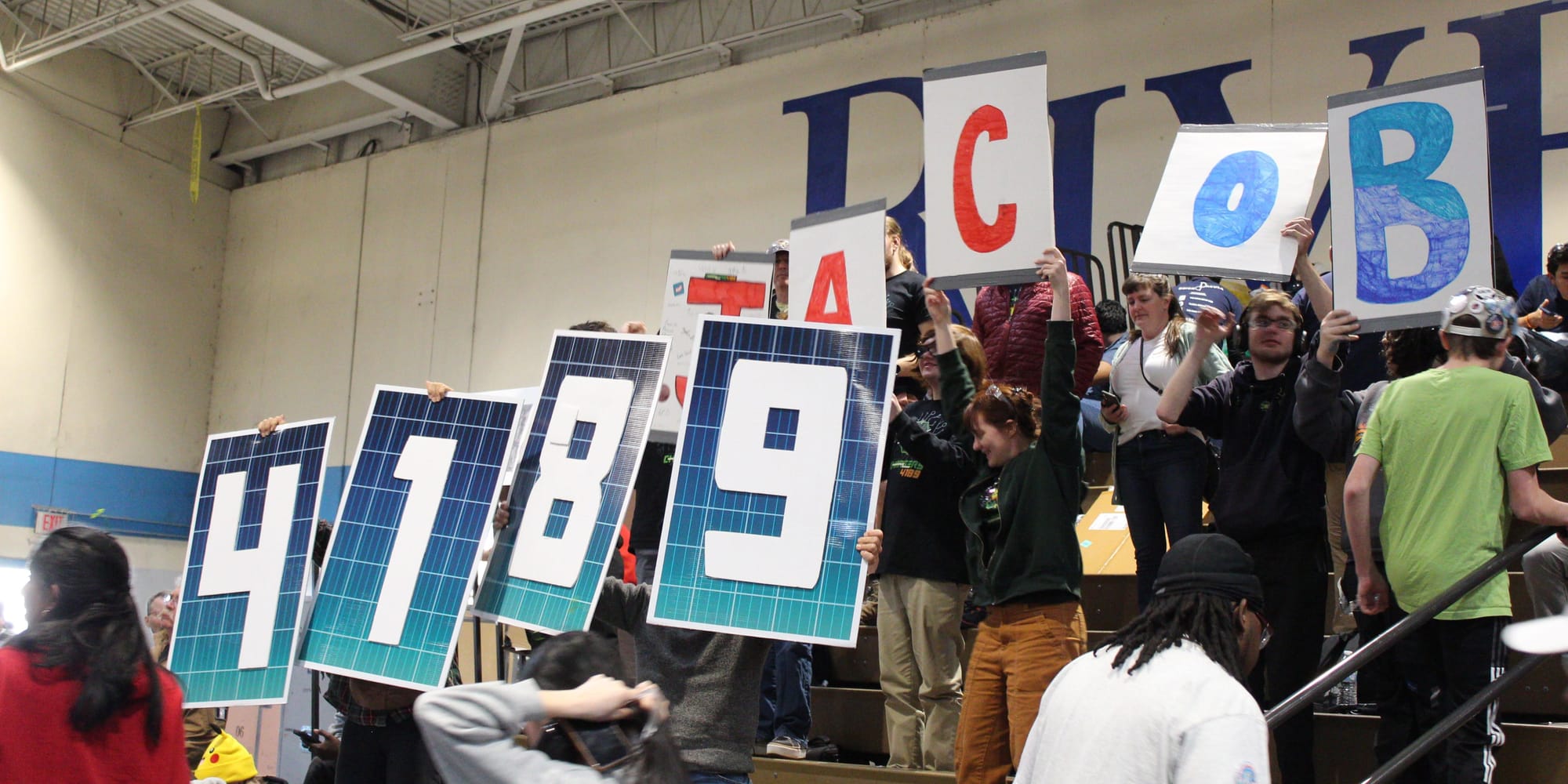
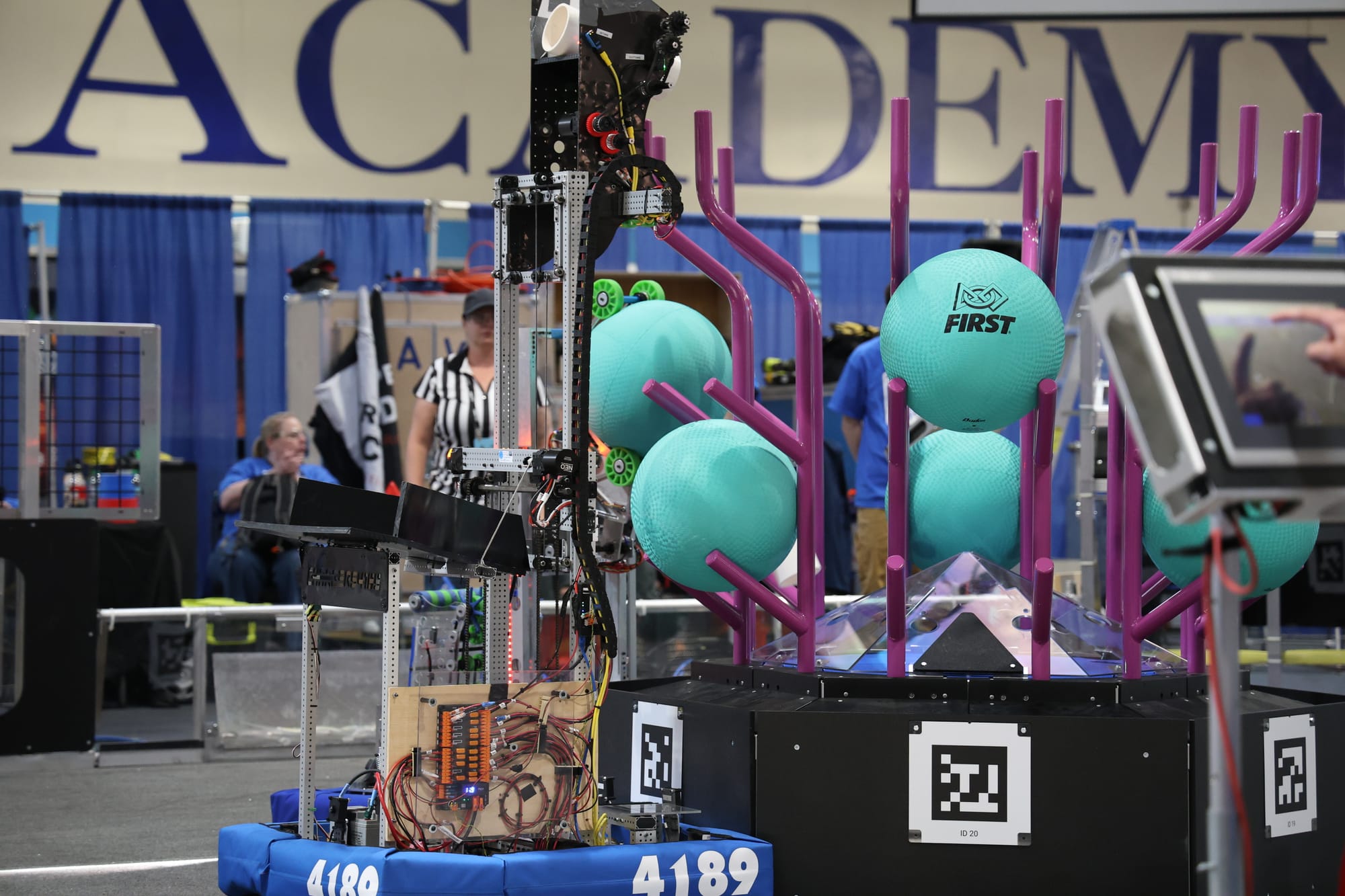
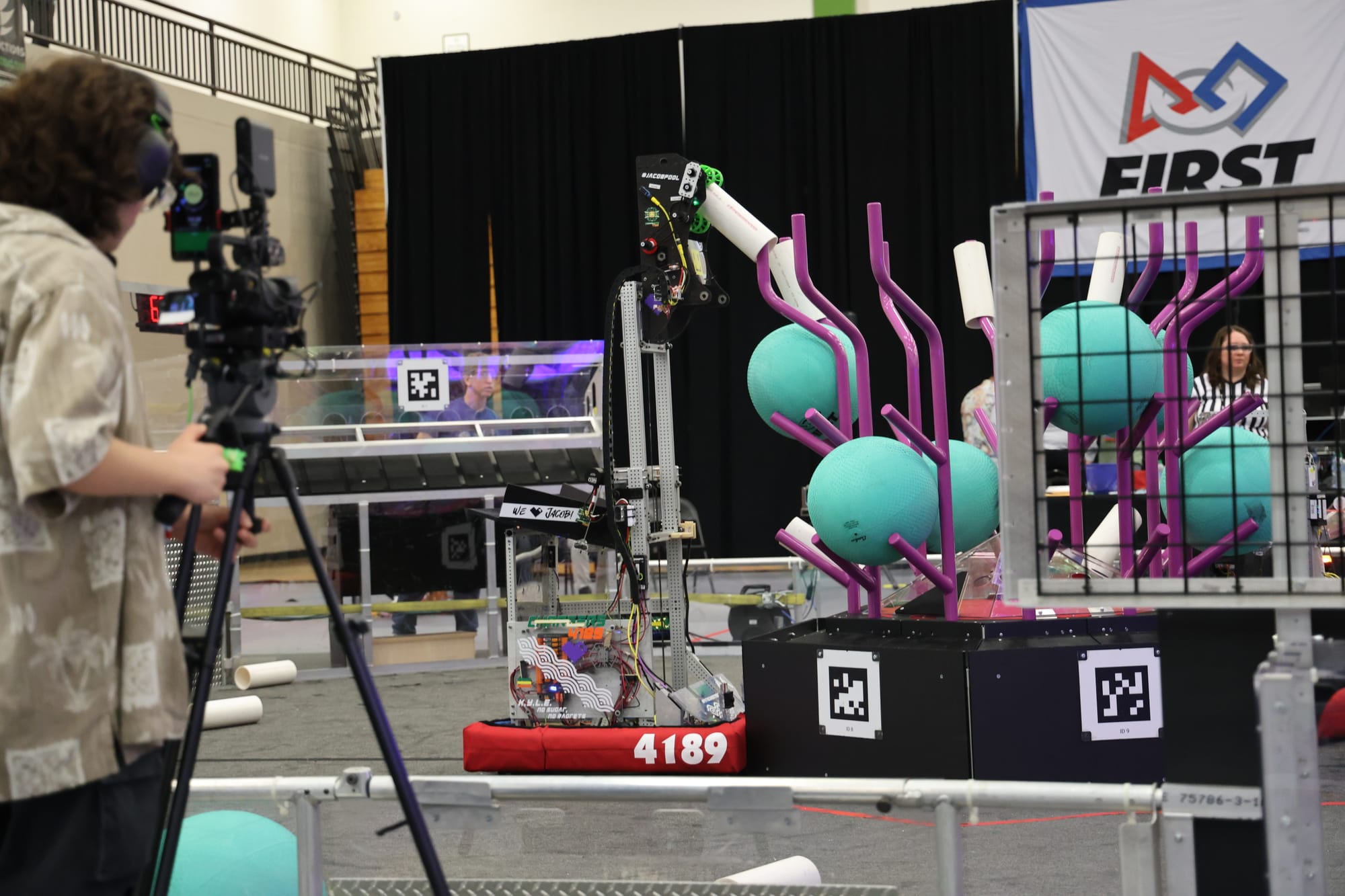
While we didn't make it to state (ranking 48th), our team has significantly improved this season. As shown by high-ranking robots worldwide, our design was successful as it reflected the same design principles they used. This Wednesday, we discussed this season's necessary positives and negatives and how we plan to improve for future seasons.
Key Positives
- Build Speed: We could design, build, and execute the robot quickly, especially using a standardized system.
- The established standardized parts and manufacturing system dramatically streamlined the build process. This reduced the need to customize parts and made assembly more efficient.
- Team members took ownership of specific mechanisms and functions. This led to a deeper understanding of the robot and faster problem-solving.
We also did a good job with identifying what problems we had, especially after we went to comp, and then making an outline for, okay, these are what we need to do the first couple days at the comp, and then these are what we want to improve on.
The DE practice field, that one day, told us 80% of the problems that we had with the bot. And we immediately fixed them and were prepared for our first comp.
- Julia & Coby
- Communication:
- Decision-making involved the whole team, and all voices were heard and considered, especially those of department heads.
- Discord was used to aid in communication with everyone. It facilitated rapid information sharing, collaboration, and coordination among team members, starkly contrasting with previous years, when communication relied more on in-person interactions.
These debrief meetings have definitely, essentially planned out what we were going to do for the week before competitions. And, that highlighted the priorities, and made sure we got things done in a timely manner, and also [control] what we wanted on the robot.
- Caleb
- Vision:
- The programming department successfully developed and implemented a vision system, enabling the robot to align and perform tasks autonomously.
- The initial code development during the off-season benefited the vision system and provided a solid foundation for the in-season implementation.
Key Areas for Improvement & Action Items
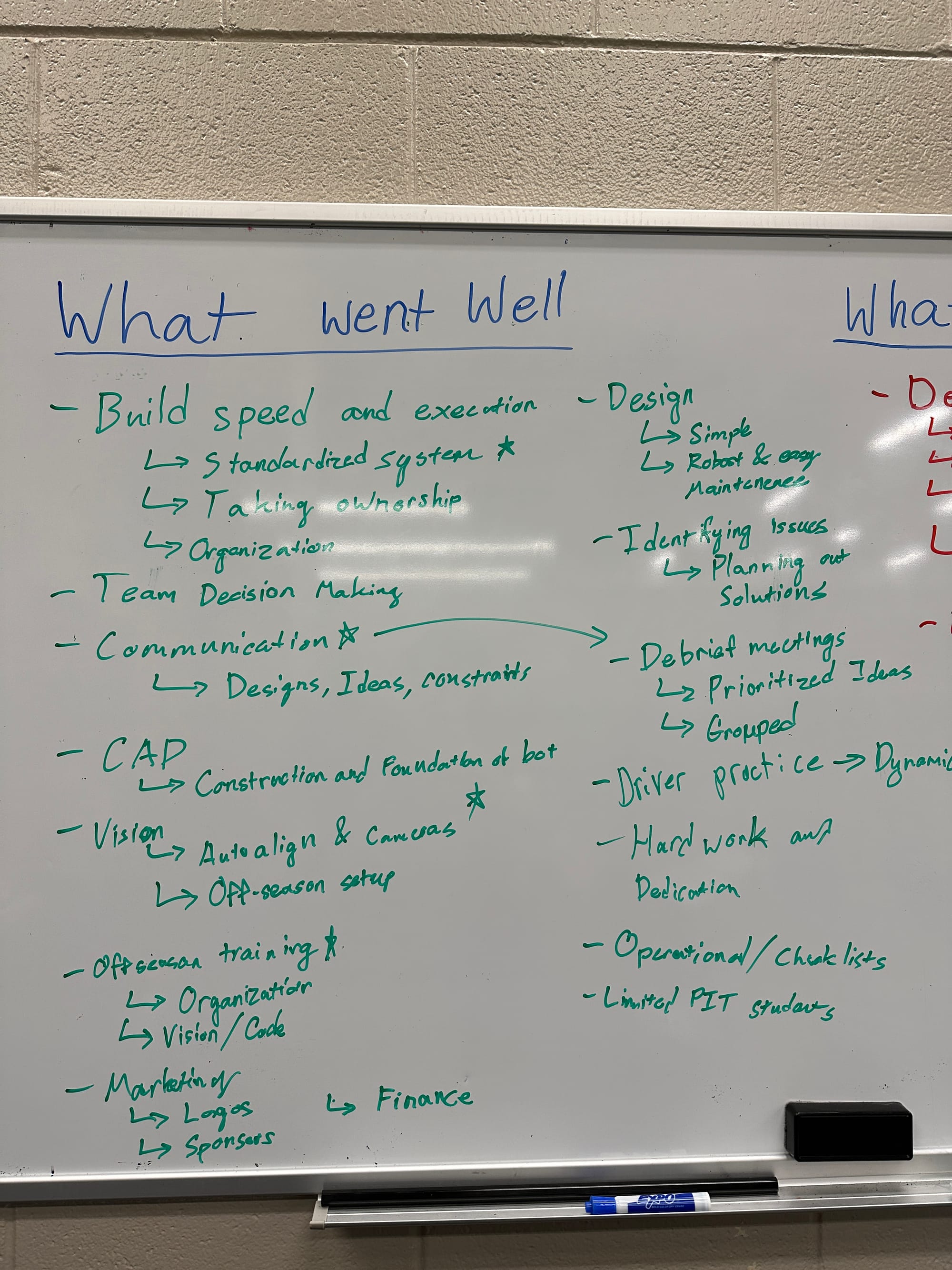
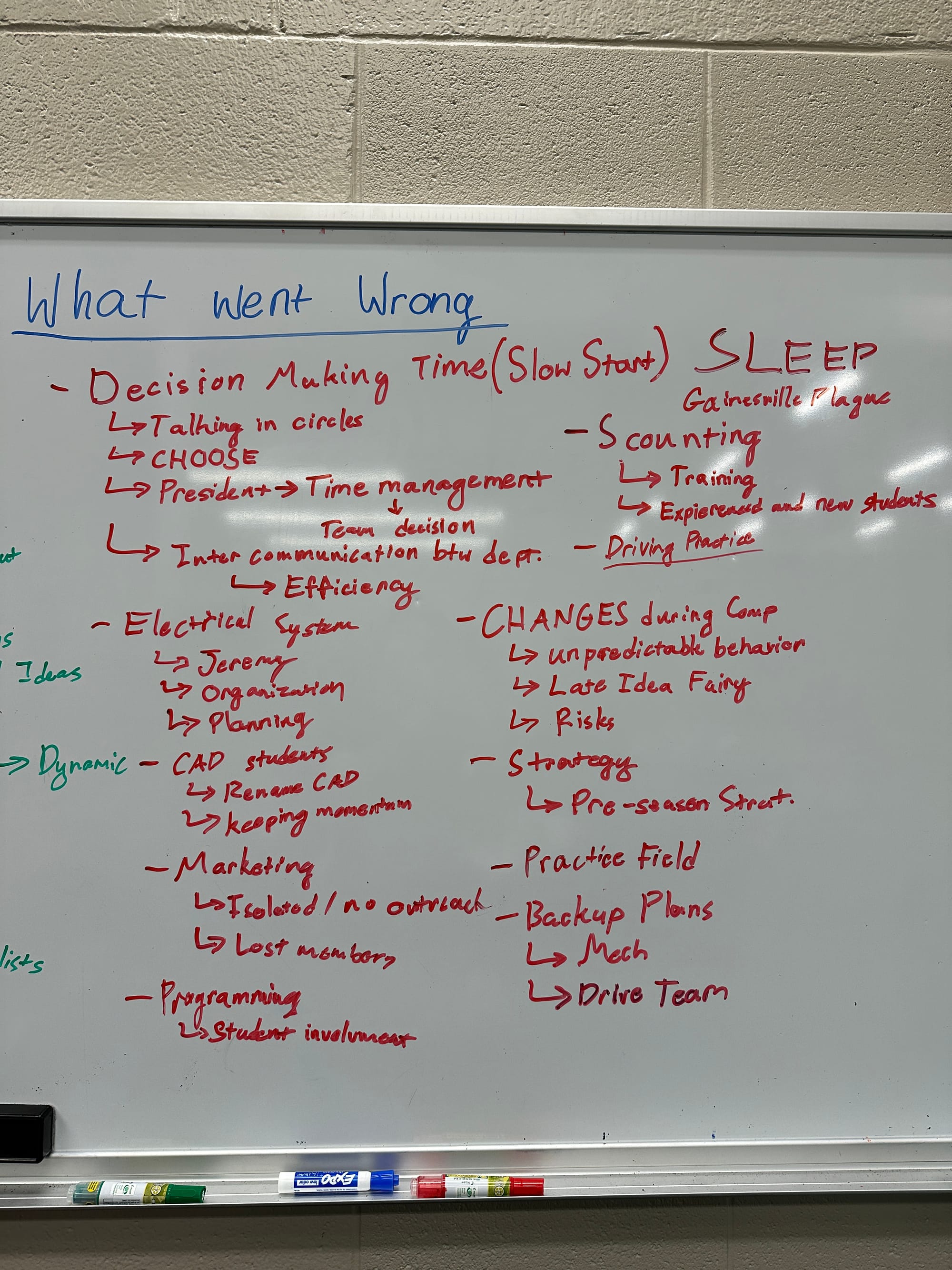
Whiteboard lists of what went well and what went wrong this season.
Competition
- Preseason Strategy & Planning: More emphasis on strategizing and planning before the game is revealed.
- Devote more time to preseason strategy sessions.
- Develop hypothetical strategies based on potential game types.
- Analyze past games to learn practical approaches and avoid pitfalls.
I do think we need to put more emphasis on preseason strategy and preseason planning kind of as a going forward thing. There was I think a lot of emphasis put on like we know the game we'll start strategy. I do think there are things that we can start strategizing beforehand. Obviously you don't know the game, you can't start strategizing mechanisms or like strategy of the game, but you can strategize your team.
- Coby
I think the one part that we didn't really address, the strategy. The strategy I don't think we had a strategy going in, and when I saw North Gwinnett and saw them only score on the near side and not even try on the other side, I was like, oh, they did a time analysis.
- Bradford
- Time Management: Improving the planning of sessions and allocating them appropriately.
- Team members often underestimated the time required to complete tasks, leading to overcommitted schedules.
- Pad all task estimates by a factor of 1.5x-2x or double it again.
- We sometimes prioritized making things "perfect" over achieving a functional baseline.
- Aim for a functional baseline first, then refine later if time permits.
- At the start of the season, define the "must-have" and "nice-to-have" features.
- Establish a clear deadline for feature completion and a "cut off" point for adding new features.
- Difficulty aligning mechanical, programming, and electrical teams to operate in tandem or to have a set schedule with equal time allocated.
- With training and experience, better estimations of when a task can be completed will eventually improve.
- The emphasis on team agreement can sometimes hinder the timely decision-making process, and there wasn't a central decision-making authority.
- Have the president the authority to make final decisions to break logjams in decision-making.
- Team members often underestimated the time required to complete tasks, leading to overcommitted schedules.
I feel like when we did make schedules during this competition we used up all the days we didn't we couldn't meet them because we often just didn't have enough time and we need to multiply everything by one and a half [for a] realistic scheduling.
- Emmett
We could have gone a little bit faster in the beginning [Weeks 1 & 2]. It was very democratic but also very slow because we just kind of talked in circles and didn't make any progress. And I do think pushing for a decision [even] if its not be the best decision, but if you looked at 20 decisions and think that you have the proper one that's the one you should go with. There can always be a better decision that can be [made].
...
Like president makes the final call that's how it should be. But the team should make the decision as a whole and so then if the president [disagrees], you know the president should have the experience and knowledge to say 'hey, this is not going to work.' It's not so much like the president is saying this is the one we're going with. It's more so like time management and just making sure that the team doesn't spend unnecessary time on it.
- Coby
- Competition Scheduling: Schedule competitions later in the season to allow more time for modifications before state (aim for weeks 2 and 4, with state being week 6).
- Scouting: Implement a sustainable scouting system, including training members and exploring app-based solutions.
- Develop a simplified scouting system that is accessible and easy to implement for smaller teams.
- Assign trained students in smaller groups to scout specific teams to alleviate time.
- Train team members on effective scouting techniques (what to look for, how to record data).
- Explore existing scouting apps or platforms to streamline data collection and analysis (Love It app, etc).
Staffing
- Staff imbalance across different departments (e.g., a shortage of dedicated CAD designers) led to bottlenecks and workload disparities.
- We can expand recruitment efforts to attract more students from throughout the county.
- Implement an application process for all departments, which helps find students interested in specific departments.
- Renaming CAD to "Digital Manufacturing" can help students understand its meaning. Additionally, changing CAD to a mechanical subcategory can help.
- A growing concern this season was our dependence on a few key individuals, making the team vulnerable when those people were unavailable.
- Delegate: Delegate power and create more efficient teams. Involve more junior and beginner students.
So we've mentioned just not having the people or resources to do CAD as effectively. Would it help if we had mechanical a little bit more involved with the CAD?
It truly should be. I mean I do think they need to be separate departments.
There is value to having mechanical at least know how to do CAD. At the very least it's really annoying when I have people like 'hey here's the CAD model go build it' and they don't even know how to interact with the program. So 'how do I get that measurement' kind of at least the basics of knowing how to use it is really important.
- Amelia & Coby
The quote above can be solved through recruitment and training. As Amelia raised as a concern, the mechanical team should know how to use the CAD program, or the CAD team should provide materials that are easy to understand (E.g., printed layouts). However, "digital manufacturing" (CAD rebranded) should still exist as a separate but subcategory of mechanical to focus on CAD solely.
Practice
- Practice Field: Emphasize the need for a more accurate practice field early in the season.
- Secure a more accurate practice field, or if necessary, build one.
- Use the AG barn over near the school.
- Schedule DE practice sessions early in the build season.
- Implement dedicated defense practice.
- Secure a more accurate practice field, or if necessary, build one.
- Backups: Develop backup plans for staffing roles and consider potential unforeseen circumstances (illness, accidents, etc.).
- Driver Practice: Primary, secondary, and backup drivers need more driver practice before competitions, including defense practice.
I think this season, we put a lot of faith in planning. ... We need to have plans A, B, and C lined up, not just for staffing. Like, unforeseen circumstances will always happen. And we should have had more driver practice before, for both our primary, secondary, and backup driver beforehand to fix a lot of these issues. Which I think that eats into the time that your primary driver can drive, but it also saves you if the primary driver gets sick.
- Coby
Off-season
- Safety: Make sure all members learn how to use tools safely. We must have clear rules.
- Training: Many of the issues we've encountered this season would have been avoided by training, specifically in conventions, strategy, design, and more. Improving our courses and teaching can help our in-season performance.
We need enough people that are actually able and competent to do that. But I also think it's important to keep in mind that we tend to attract people who are a little less likely to ask for help if they don't understand something. And having that sort of mindset, even among the older students, to be watching for the incoming kids when they seem to be getting hung up on something. That's a really useful little push to give them the opportunity to ask 'oh yeah I just was confused about this one thing' and then you can get them back on their foot.
- Mayday
- Outreach & Marketing:
- Targeted flyers/posters in specific areas (e.g., marketing posters near the art room).
- Consider Dragons Day (Club Rush) demonstrations.
- Highlight the diverse skills applicable in robotics (art, finance, etc.).
- Advertise around Jackson County, outside of Jefferson High School.
Outreach really needs to be at the top of the list going forward because we need to market ourselves not just as a robotics club but also as, do you like to build things and take stuff apart? Mechanical. Do you like programming? Programming. Do you like finances? Do you like art? You know, these are all the things that we can do a part of.
Yeah, some of that stuff isn't, necessarily- you would think of robotics. You would think that, oh, we need a finance person for the robotics team or we need [an] art students to do that.
- Coby & Julia
- Member Engagement/Applications:
- Implement an application process (Google Form) to gauge member interest and commitment levels. This should serve as a barrier to entry for those looking to play around.
- Keep initial meetings open for exploration.
- Have open meetings at the beginning to understand the teams.
The whole point of the application is, okay, anyone who's not actually interested in this will not care to fill out an application
- Project-Based Learning:
- To teach various skills, incorporate example projects (robot cart, rebuild flunky, mini FRC bots).
Department Specific
- Finance Department:
- Create club accounts for robotics, revrobotics, and more
- Don't require Bradford to do all the purchases
- Look into incorporating the finance department with basic mechanical engineering knowledge
- GitHub Organization:
- Improve GitHub commits and consistent naming conventions with training.
- Prune branches weekly.
- CAD Improvements:
- Standardize best practices and workflows in CAD.
- Focus on assembly training early on.
- Electrical Improvements:
- Prioritize scheduled time for electrical work.
- Improve the CAN system.
- Look into wire routing.
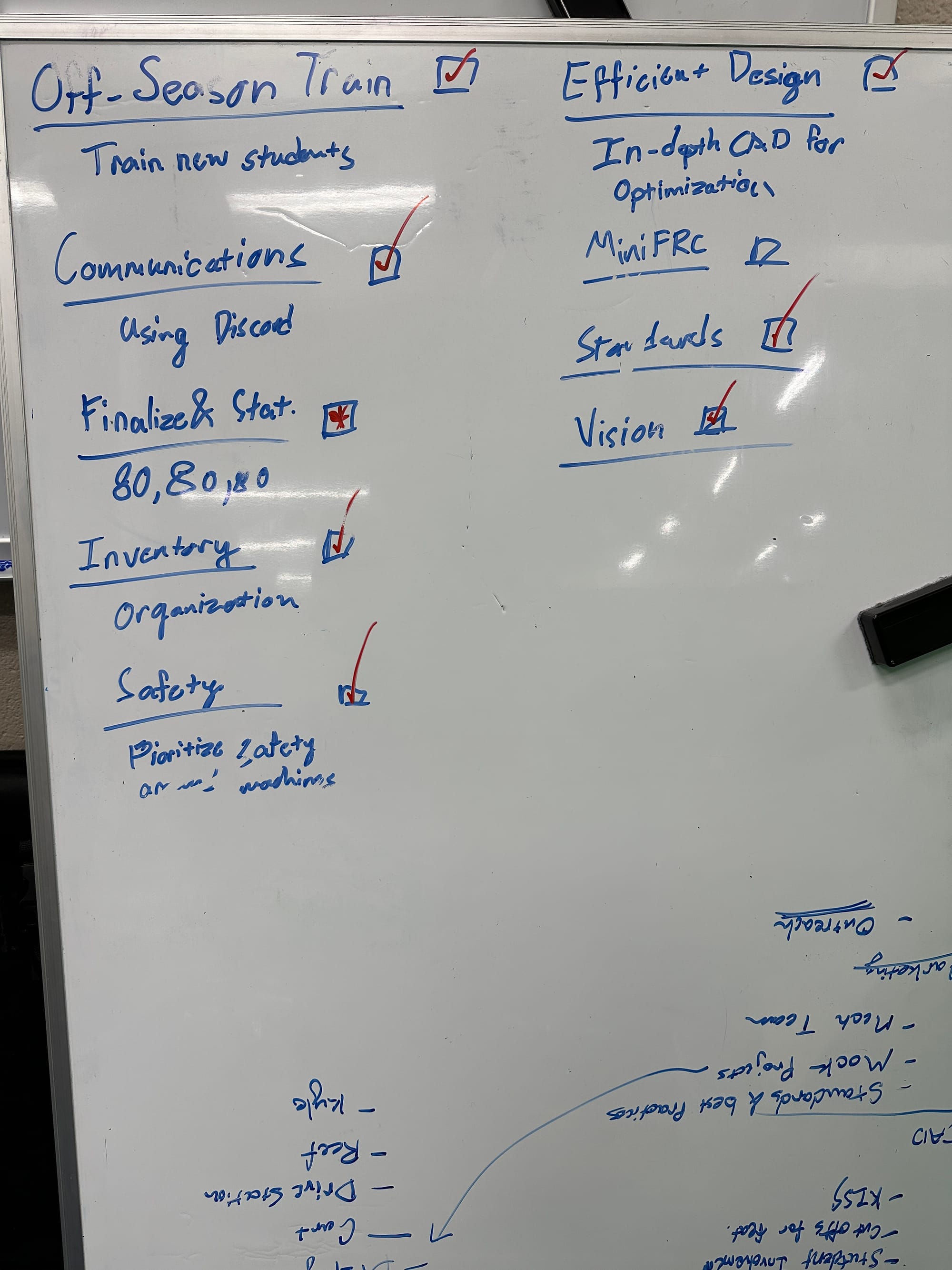
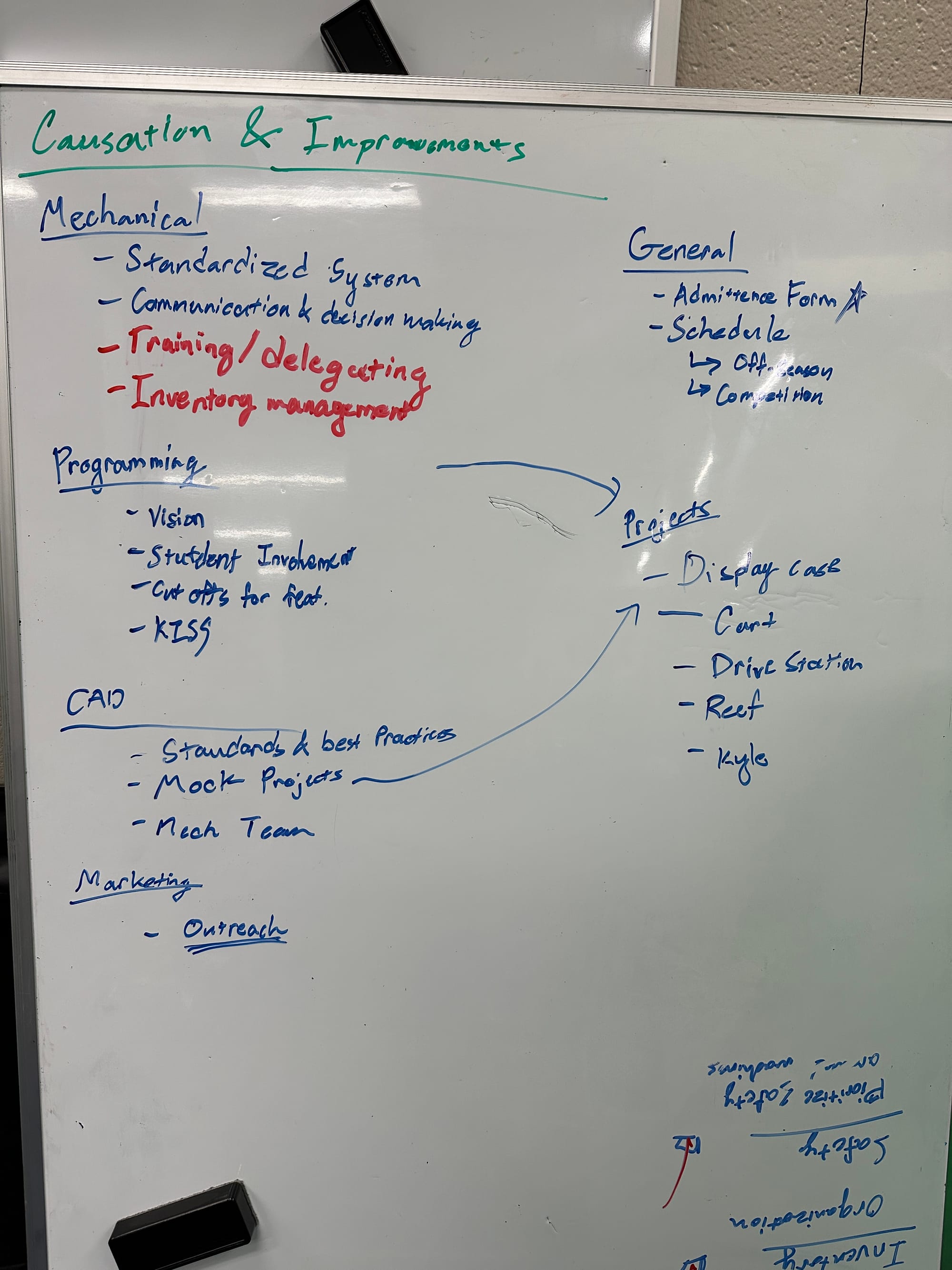
On the left is a checklist of items we wanted to accomplish this season. On the right are improvements and causality of what went well and what went wrong.
Learning from Mistakes
- Electrical: The electrical setup must be considered earlier in the planning process and laid out with an electrical department.
- Last Minute Coding/Changes: Not much work should be done at the last minute, and that time should have been allocated earlier.
- Late Good Idea Fairy: Do not implement ideas that don't mesh with the current system near the deadline.
- Good Idea Fairy: Ideas that are thought of and implemented without considering their consequences or downstream impact.
- Changes during Competition: Major changes should be frowned upon, even if they're easy solutions. This leads to mistakes in code, unpredictability, and massive risks.
Topics for Next Meeting
- Officer Positions:
- Discuss and finalize officer positions.
- Off-Season Schedule and Projects:
- Sketch out a plan for both the off-season schedule and the competitions.
- Determine specific projects for the offseason and how they'll be organized.
- Develop a plan for each department.
- Training Programs and Resources:
- Each department should lay out its training goals.
- Evaluate whether to create a custom learning website.
The main takeaway is that while we had a good year, more focus should be placed on planning and training to ensure greater success in future seasons.