
Mechanical Updates - Week 7

Good morning mechanical department,
Today, we addressed and resolved a roadblock that has delayed us over the past few days. Here is a recap of our discussion.
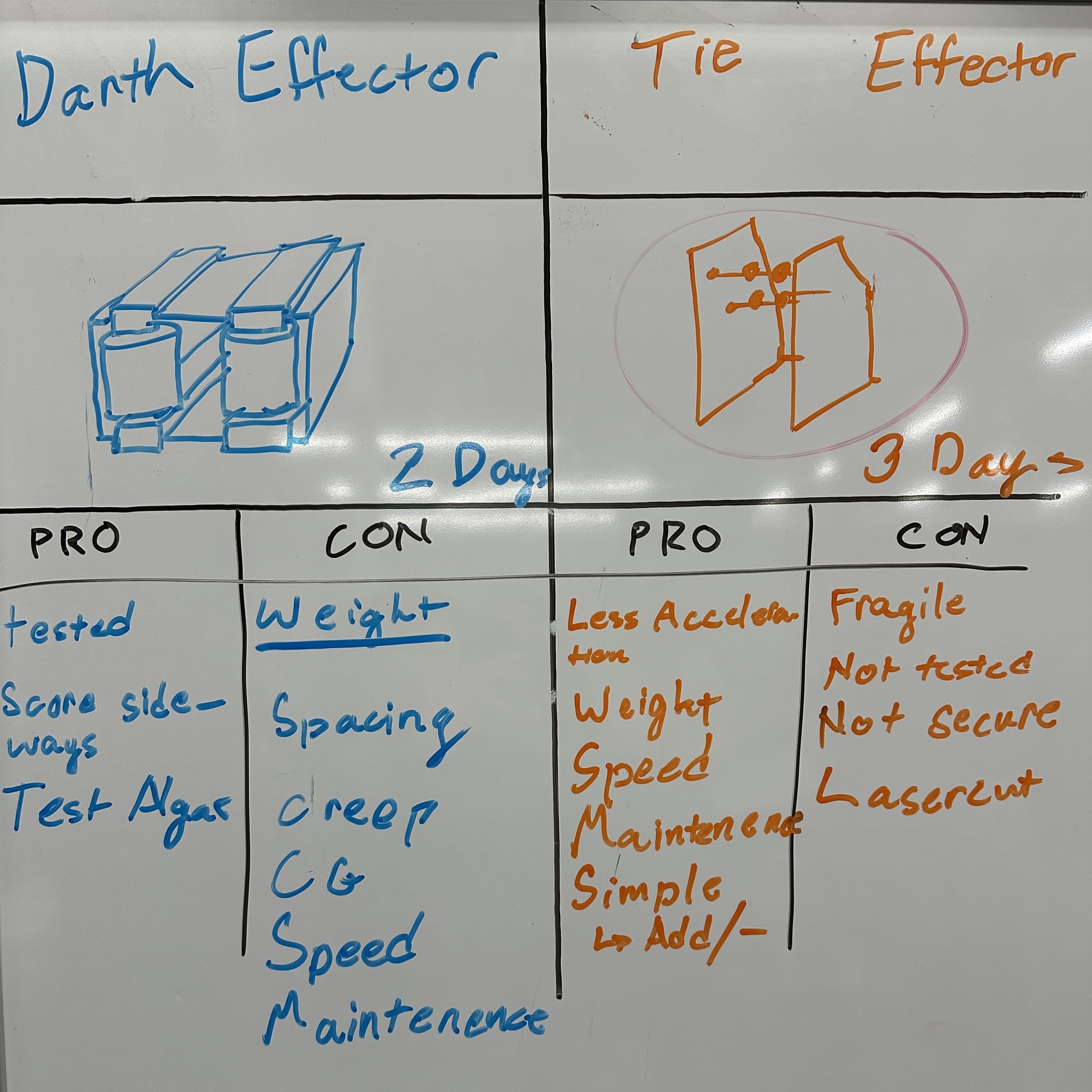
First, we outlined the pros and cons of the two mechanisms that will become our main Coral Effector. Bryce's design, nicknamed the Darth Effector, is a 3D-printed mechanism with motors driving wheels along the sides of the coral. Bradford's design, nicknamed the Tie Effector, is more straightforward, with only one motor driving the top and bottom coral.
Darth Effector
Pros:
- Tested and iterated multiple times.
- It took a lot of time and progress with this effector.
- Ability to score sideways
- We debated many times that losing this is not a significant dealbreaker.
- Ability to be tested with Algae and could be used as an Algae effector
- With its current design, the idea of using it for algae can be tested.
- 2 Day turnaround
- Since we have experience and the print will come in the next day, it will be faster to complete mounting, wiring, and testing.
Cons:
- Weight
- A significant drawback of this design is its weight. These values are preliminary, but based on very recent results, their safety factor is 1.8.
- A safety factor expresses how much stronger a system is than it needs to be for an intended load. For example, a FOS of 1 at 200 lbs can withstand 200 lbs before breaking. A FOS of 2 at 200 lbs can handle 200 lbs but will break at 400 lbs. Typically, these range from 3 to 4 for appropriate loads. This is under NORMAL conditions; an algae hitting the elevator in its extended position will not be considered.
- Acceleration is also a major concern. If the effector can travel with the elevator as the robot moves, this would greatly reduce cycle times. Coby talked about how creep and fatigue can occur with a heavier effector. This can already be seen with the elevator and its plates/tubing bending due to weight.
- Speed is another factor. A lighter effector can be quickly zipped to each level, which means the effector is in a vulnerable state for less time and an improved cycle time.
- The center of gravity can be improved with a lighter effector with less mass in the air.
- Spacing
- The Coral Effector fits theoretically–along with the v3 with better fitting arrangements–but there are still concerns about moving the elevator back or reprinting the effector.
- Maintenance
- With its custom 3D-printed mounting and housing, concerns were raised when the 3D-printed attachments to the effector broke when the elevator rose with a misplaced coral.
- This housing also reduces the ability to add other mechanisms due to its size.
Tie Effector
Pros:
- Weight
- With less weight, acceleration is less of a concern as forces decrease with weight. Along with other reasons, speed, CG, and safety factors are improved with a lighter design.
- Maintenance
- The design is much simpler, with only two carbon fiber plates holding the mechanism together. This simplifies required maintenance and allows adding more features or mechanisms.
Cons:
- Fragile
- With fewer components and on a big plate, Wil raised a valid concern about the possibility of the effector breaking in contact with bots or field elements.
- Not Tested
- With the hours of work and time spent prototyping with the Darth Effector, not much time has been spent with the Tie Effector. We'll need to pour more time into the tie effector with prototyping, testing, and fixing issues that come up.
- Not Secure
- Again, the mechanism can be less secure with fewer components and two plates than the Darth Effector.
- Lasercut
- Since the Tie Effector is made of carbon fiber, manufacturing it won't be easy. If changes or repairs are needed, this will require more time. Additionally, more plates will need to be on hand for quick repairs.
- 3 Day turnaround
- Because it's a brand-new effector that has not been tested, the turnaround time is longer than that of the Darth Effector.
Discussion Points
After outlining the pros and cons of each mechanism, the team discussed their opinions and concerns. Here is what was essentially said.
The mentors agreed that the Tie Effector is the best choice due to its simplicity, lightweight design, fewer acceleration forces, and freedom for more additions. Julia noted that some of us could be married to the Darth Effector design because we've poured much time and effort into this effector, which I agree with.
Some officers didn't have a preference, and some preferred the Tie Effector. Jacob highlighted the concerns about the acceleration and the fact that less maintenance is required. Mr. Farmer also added his concerns about accelerations and forces that could break the Darth Effector, agreeing that the simplest is best.
Moving Forward
With the benefits discussed here, the mechanical team and mentors have decided that the Tie Effector is the best route for the Coral Effector. The Tie Effector has improvements in acceleration, weight, and maintenance concerns. More testing and prototyping will be required to score Coral consistently, which is worthwhile for reliability and simplicity.
The Tie Effector, climber, and intake task schedule will be released soon.